
Learning Platform for Training Providers: Digitise Your Own Courses

When a Training Provider Needs Its Own Learning Platform
A custom learning platform starts to pay for itself the moment your pass rate becomes the product. If you prepare people for a state-regulated exam, what you sell is not knowledge but the probability that someone passes on the day. An off-the-shelf LMS is of limited help there, because it knows neither the syllabus nor the exam format it will ultimately be judged against.
Universities, corporate L&D departments and apprenticeship employers are all well served by existing platforms. The small and mid-sized training providers who move people through one specific licensing exam are not. So they improvise: a generic LMS, a quiz tool alongside it, a spreadsheet, and a great deal of undocumented experience in their trainers’ heads.
This guide uses Germany’s security licensing exam as its running example, because every requirement in it is public and precise. It covers where standard software breaks down, how to digitise your course offering around your own material, what it costs and how a project runs. The pattern transfers to any regulated exam with a published syllabus.
One Job, Twenty-Six National Rulebooks
Private security is licensed nationally, and the requirements diverge far more than most software vendors assume.
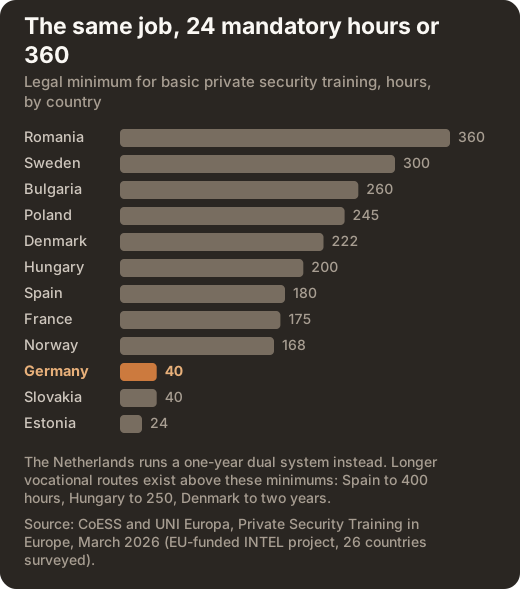
The mapping study Private Security Training in Europe, published in March 2026 by CoESS and UNI Europa under the EU-funded INTEL project, surveyed 26 countries and puts the overall span of mandatory basic training at 20 hours to a full year. Among the countries it lists individually, Romania requires 360 hours, Sweden 300 (140 in school, 160 in-company), Bulgaria 260, Poland 245, Denmark 222 as the legal minimum and up to two years through the vocational route, Hungary 200 to 250, Spain 180 for the basic legal exam and up to 400 for full professional qualifications, France 175, Norway 168. At the lower end sit Estonia with 24 hours and Germany and Slovakia with 40. The Netherlands runs a one-year dual system, one day in school and four in the company.
Three findings from that study matter commercially:
- Basic training is set by national law in almost every country surveyed, Austria being the exception. You do not get to design the syllabus, so your software has to follow someone else’s.
- Refresher training is a legal requirement in 57 percent of those countries. That turns exam preparation from a one-off sale into a repeat obligation, and somebody has to keep track of who is due when.
- Training still leans towards soft skills rather than new technology. The study treats this as a growing gap, given that the EU AI Act will require substantial training for the human oversight of high-risk AI systems used in security work.
A market that is fragmented by law, renewed on a cycle and expanding into new subject matter is a good market to sell courses into. It is a poor one to serve with a generic product.
The Worked Example: Germany’s Section 34a Exam
Germany’s Sachkundeprüfung nach § 34a GewO is worth walking through in detail, because the regulator has already published everything a platform would need.
Anyone working in the security industry needs at least a 40-hour instruction course. For part of the work that is not enough. The full examination is mandatory for patrols in publicly accessible spaces, retail loss prevention, door supervision at nightclubs, and supervisory roles guarding refugee accommodation and large access-controlled events. Anyone running a security firm needs it in any case.
The exam covers seven subject areas fixed in the security services regulation: public safety and order law including trade law, data protection law, civil law, criminal and criminal procedure law including the handling of weapons, accident prevention rules for guarding services, dealing with people including de-escalation and intercultural competence, and the fundamentals of security technology. The chambers of commerce then publish a framework syllabus that breaks those areas into individual learning objectives and assigns each a taxonomy level, meaning the depth at which it has to be mastered.
Anyone building software for this market should look closely at that last point. The learning-objective structure that every other project has to invent first already exists here, in public, in a form you can implement.
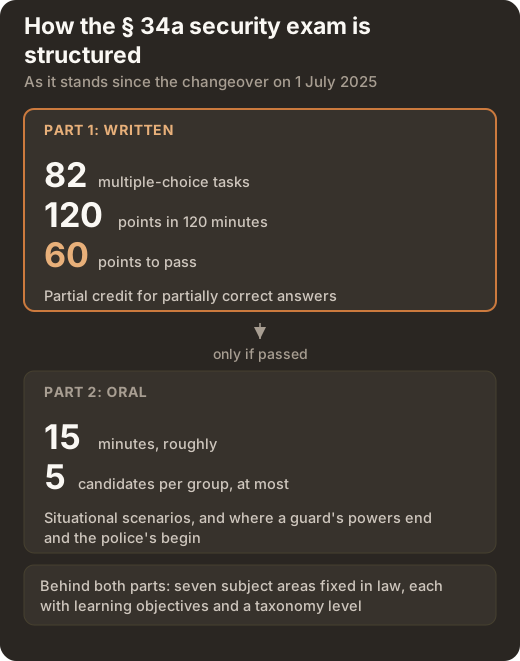
The format is equally fixed. The written part runs 120 minutes and, since the changeover on 1 July 2025, contains 82 multiple-choice tasks worth 120 points in total. The pass mark is 60 points, and partially correct answers now earn partial credit rather than nothing. Candidates who pass the written part go on to the oral: around 15 minutes, in groups of up to five, built on situational scenarios and questions about where a security officer’s powers end and the police’s begin.
How many candidates fail this particular exam is not published. For chamber exams as a whole, the figures are. In its national further-training statistics for the 2024 reporting year, the DIHK records 54,405 people sitting an advanced vocational examination and 38,570 passing, a pass rate of roughly 71 percent. Close to one attempt in three fails. Individual qualifications sit lower: the chamber qualification for protection and security staff, Geprüfte Schutz- und Sicherheitskraft (IHK), records 596 passes from 938 candidates in the same year, about 64 percent.
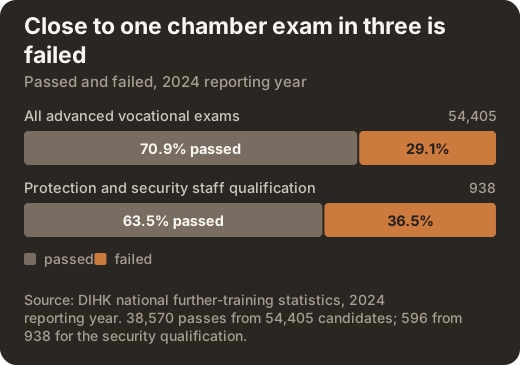
That rate is your business model. Every failed attempt costs an exam fee, a wait for the next sitting and a good deal of motivation, and in publicly funded programmes it comes back to you as a reported outcome.
The market behind it is not a small one. Germany’s central security register lists roughly 207,000 security staff across roughly 5,900 companies. Preparation courses are advertised at somewhere between 800 and 1,800 euros and can be fully funded at accredited providers through the employment agency’s training voucher. Public money means a documentation duty attached to every course.
You Already Have the Content. What Is Missing Is the Software
Training providers preparing people for regulated exams rarely have a content problem. The scripts, the slides, the practice questions and the hard-won knowledge of exactly where candidates come unstuck all exist, often built up over years. What they are looking for is software that turns that material into a digital course offering. This is usually where the search stops, because the market splits in two directions and leaves out the middle.
Platforms that bring their own content. Ready-made video courses and question sets on subscription. Your own material sits unused, and you end up selling the same course as the provider two streets away, which leaves price as the only thing to compete on. Pre-produced content also ages with every change to the exam. On 1 July 2025 the written part of the German security exam moved from 72 tasks and 100 points to 82 tasks and 120 points, with partial credit alongside it. Every video explaining the old structure was obsolete that day.
LMS and authoring tools that only store content. Here you can upload your own material, but it comes out in the same shape it went in: a PDF, a slide deck, a video, now behind a login. That is digitisation without interaction. The learner still reads, rather than being questioned, corrected and brought back to the same point at sensible intervals. This is the static quality providers mean when they say they could not find anything that fit.
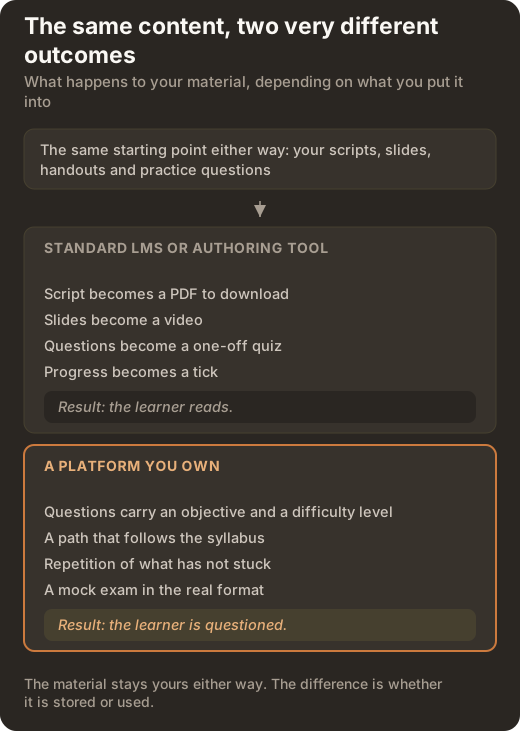
What is needed sits in the middle: software that treats your content as the raw material and makes something active out of it. Your questions become a measuring instrument, your scripts become the knowledge base an AI tutor answers from, and the official syllabus becomes the structure both hang off. The material stays yours, it finally gets used, and when the exam changes you change it yourself instead of waiting on a vendor whose priorities lie elsewhere.
Why Off-the-Shelf Platforms Fall Short
An LMS is a distribution system: create a course, upload material, record attendance. Exam preparation asks for something else. In practice it snags in five places.
The structure follows your folders, not the syllabus. In the LMS the unit is called “Module 3: Law”. In the exam it is “subject area 1, objective 1.4, taxonomy level 2”. Until those two are connected, no software can tell you which objectives a learner has not yet mastered.
The exam format cannot be rebuilt. Several correct answers per task, partial credit, 120 points spread across 82 tasks, and the clock running. A learner who practises with single-choice questions and a percentage score is training for a different exam than the one they will sit.
There is no pass prediction. Standard analytics report course progress and completion. They do not answer the question that matters in the last weeks before a sitting: who in this cohort would pass today, and what is holding the others back? Without it, your trainers are steering by feel.
Compliance records do not appear by themselves. Publicly funded programmes require documented learning time, often with live supervised time shown separately, plus accessibility. Reconstructing that afterwards from a generic system means days in spreadsheets before every audit.
The licence model works against you. Training providers earn per cohort, so a per-learner licence puts a price on exactly the growth you are chasing. And the question bank curated over years, usually the most valuable thing in the building, ends up sitting inside someone else’s product.
From Syllabus to Learning Path: Five Building Blocks
The architecture is the same for every regulated exam:
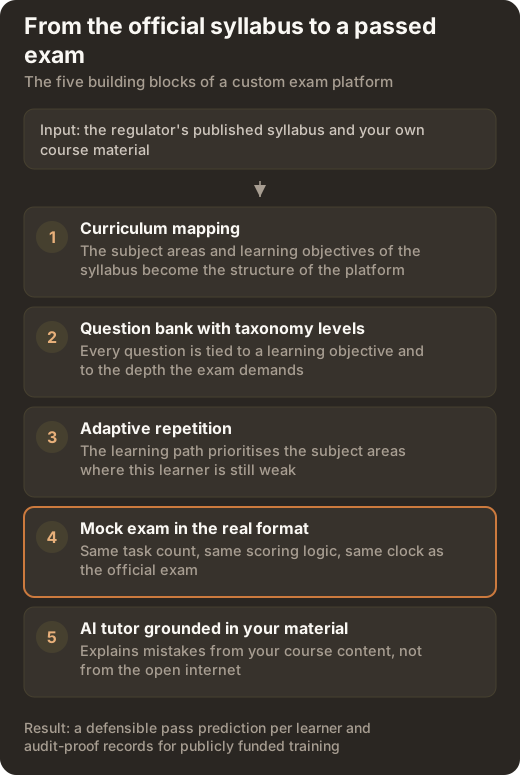
1. Curriculum mapping. The official syllabus becomes the data structure of the platform: subject areas, learning objectives, taxonomy levels. Everything else hangs off it. The step looks unglamorous and still decides what the finished product is worth.
2. A tagged question bank. Every question gets a learning objective and a difficulty level, which is what turns a pile of practice questions into a measuring instrument. Existing questions in Word, Excel or PDF import easily enough; the work is in the tagging, and AI now takes on a good share of it.
3. Adaptive repetition. The platform comes back to what has not stuck and spaces out what has. For fact-heavy exams built on legal rules and powers, spaced repetition is one of the most effective levers available.
4. A mock exam in the real format. Same task count, same scoring logic including partial credit, same clock. It takes some of the nerves out of the exam day, and it gives you the pass prediction the standard LMS never produced.
5. An AI tutor grounded in your material. An assistant that explains a mistake using your course content rather than whatever it found online. On legal subject matter, that is the difference between helpful and dangerous. In the evaluation of our university pilot, every answer carried a valid citation back to its source passage, with no invented references. For a law-based exam we would treat that as the minimum bar. Our guide to custom AI tutor development covers how it is built and what to watch for.
These blocks already exist in LearnSlice as a product for chamber exam preparation in German dual vocational training, with learning paths, adaptive repetition and mock exams, described in our post on digital exam preparation. Our own figures so far come from higher education: in May 2026, 50 master’s students at FH Dortmund used it to prepare for an exam. Afterwards 80 percent reached complete or near-complete understanding of the topic, and 70 percent found the personalised pace right for them. That was a university exam rather than a licensing exam, so it shows the teaching design holds up, not that the results transfer one to one. A new exam still does not start from zero: the existing core is fitted to your syllabus and your question bank, and what that mainly shortens is the time to a first usable version.
Beyond Security: The Same Structure, a Different Exam
Once the platform exists, adding a second exam is largely content work. That is where the leverage sits, because your course portfolio can grow without buying new software each time.
| Exam domain | Typically administered by | What the platform has to model |
|---|---|---|
| Private security licensing (national) | State authority, police or chamber | National syllabus, fixed written format, scenario-based oral assessment |
| Insurance distribution (IDD) | Chamber or national regulator | Large legal syllabus, plus at least 15 hours of continuing training per year under Article 10 IDD |
| Investment and mortgage credit advice | Chamber or national regulator | Same shape, a separate syllabus per licence type |
| Trainer and assessor qualification | Chamber or awarding body | Several fields of action, written plus a practical presentation |
| Dangerous goods (ADR), transport management | National authority | Case-based tasks, mandatory refresher cycles |
| Advanced professional qualifications | Chamber or awarding body | Several exam parts across months, progress tracked over long periods |
| Healthcare and care assistant qualifications | Regional authority or provider | Practical components, documentation duties, recurring refreshers |
| AI literacy under Article 4 of the EU AI Act (in force since February 2025) | No external exam; the duty sits with the provider or deployer | New subject matter, frequent changes, evidence of who was trained and when |
If you already prepare people for one of these, the hard part is behind you. You know the material, you know where candidates go wrong, and the question bank exists. What is missing is software that does something systematic with all three.
Cost and Timeline
A platform of this kind is neither a weekend project nor a seven-figure programme. The cost benchmarks below are derived in more detail in our guide to custom e-learning development costs; the timings are what we plan for in our own projects.
| Scope | Typical cost | Timeline |
|---|---|---|
| First usable version: one subject area, question bank, mock exam | low five figures | 6 to 8 weeks |
| Full platform: all subject areas, adaptivity, analytics, roles | roughly 13,000 to 90,000 euros depending on scope | 3 to 6 months |
| A further exam on the existing base | substantially less, mostly content and mapping | weeks rather than months |
| Operation, maintenance, content updates | ongoing, often a share of build cost per year | permanent |
The entry point does not have to be large. A sensible first scope is one subject area, your existing question bank and a working mock exam. That sits in the low five figures and is in front of a real cohort in 6 to 8 weeks, so you watch your own pass rate before deciding whether to extend it. If the number does not move, you have spent a contained amount and learned something.
Whether that beats renting is arithmetic you can do yourself: licence cost per learner times cohort size times years on one side, one-off build plus running cost on the other. The larger and steadier your intake, the sooner it tips. There is also a line that rarely makes it into the calculation, which is that the question bank and the teaching logic inside it stay yours.
To be even-handed about it: with small cohorts and standard requirements, rent a tool. Custom development pays off on volume, specificity and duration. If one of those is missing, leave it.
Data Protection, Sovereignty and Ownership
In publicly funded programmes you handle data about people who are often in difficult circumstances, sometimes on behalf of a state employment agency. Four points therefore belong in the requirements before any code is written:
- EU hosting, with a data processing agreement and a clean role and deletion model.
- AI with a training-data opt-out, so learner answers and mistakes never end up training someone else’s model. Where full control is needed, open models can run on your own infrastructure; we weigh that up in our post on custom AI with open-source models.
- Accessibility, which matters practically for this audience and, under European accessibility rules, is not negotiable.
- Ownership of code and content, agreed in writing before the project starts, so you are not tied to one vendor indefinitely.
For the questions worth putting to a vendor on AI and data protection, see our 7-point check on GDPR-compliant AI tools.
What this looks like in practice is illustrated by LearnSlice’s use in a publicly funded research project at FH Dortmund:
“We integrated a quiz-based AI platform across multiple teaching methods, from inverted classrooms to quiz-based homework. The software boosted student motivation and helped them pass exams more successfully. It adapts seamlessly to individual learning needs, which is exactly what modern higher education demands.”
Prof. Dr. Carsten Wolff, Board of Directors IDiAL, FH Dortmund
More evidence from that pilot is on our research and evidence page.
Four Steps to Your Own Exam Platform
- Review the syllabus and the question bank. Is the official syllabus available, and can your questions be mapped to individual learning objectives? That is the foundation; the rest is engineering.
- Pick one exam as the pilot. Not the whole portfolio, but one exam, one cohort and one measurable target: that group’s pass rate.
- Ship a first version in 6 to 8 weeks. One subject area complete, a mock exam in the real format, real learners. We deliberately scope that first version down to a single subject area, because only real usage shows which feature earns the next slot. Their results decide what gets built next, not a concept paper.
- Roll out to further exams. Once the structure stands, the second exam is mostly content work. This is where the distance opens up between you and providers still working from PDFs and classroom time.
If you prepare people for a regulated exam and your current system does not know the syllabus behind it, the first building block is worth a conversation. Our custom e-learning development page sets out how we work as a development partner. Based in the US? See our AI tutor for training providers and try the live demo.
Written by
LearnSlice Team