
Training Mechatronics Apprentices: Where AI Tutors Help
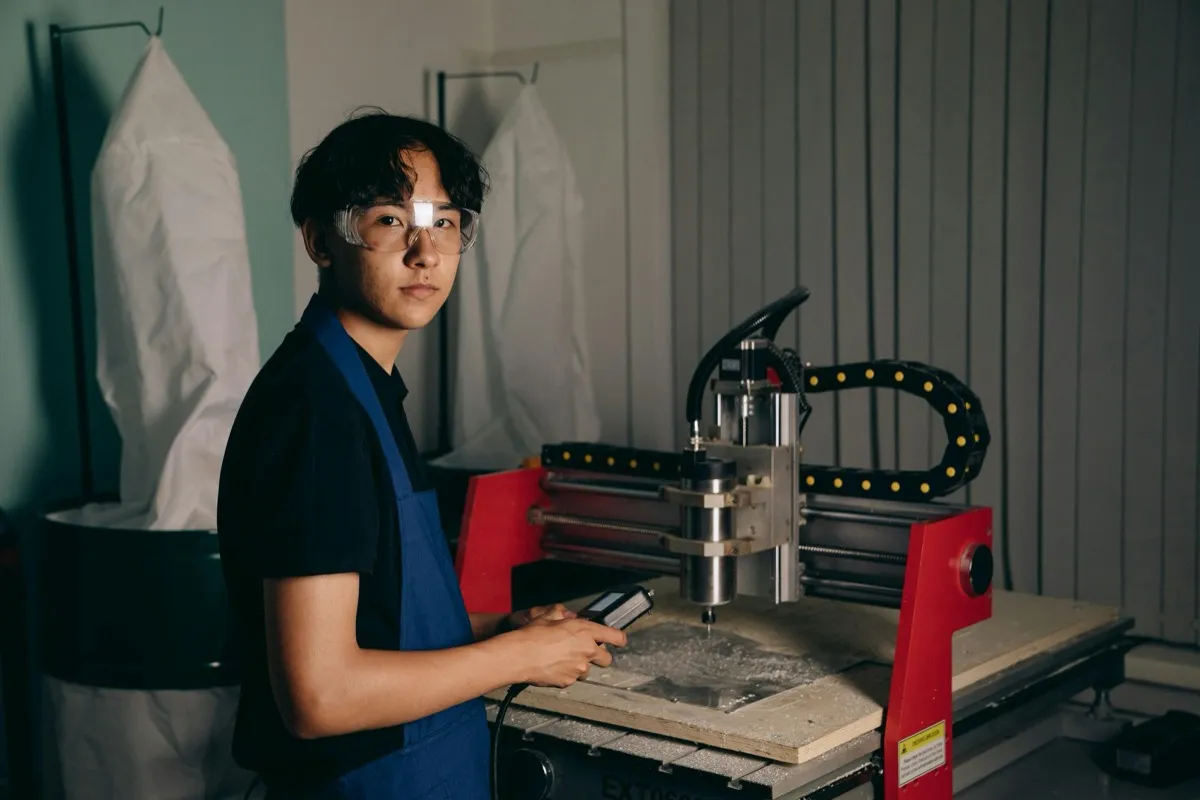
A mechatronics apprentice learns several trades at once: mechanical, electrical, fluid power, controls. Most of that learning happens on the shop floor. In the US, the federal rule recommends 144 hours of classroom instruction a year: less than four working weeks. So many theory questions come up at work, where a trainer is not always free to answer them.
Below you will find what year one demands, how much instruction time apprentices get in Germany, the US and England, and what the research says about AI tutors filling the gap. At the end are three questions to test any AI tool before your apprentices use it.
How much classroom time mechatronics apprentices get
Each country organises mechatronics apprenticeships differently, but in all three, most of the learning happens at work. Here are the three systems side by side.
| Country | Length | Instruction outside the job | Source |
|---|---|---|---|
| Germany (Mechatroniker) | 3.5 years | About 1,020 lesson hours of technical learning fields at vocational school | KMK framework curriculum and training regulation |
| United States (Mechatronics Technician) | 8,000-hour training term (time-based) | 144 hours of related instruction per year recommended, 576 in the 4-year competency-based framework | 29 CFR 29.5, DOL Bulletin 2013-07, apprenticeship.gov framework |
| England (Mechatronics maintenance technician) | 42 months typical, Level 3 | Minimum of 744 off-the-job training hours | Skills England standard ST1326 |
The definitions differ, so treat these as rough sizes rather than a ranking. Still, in every system an apprentice spends most of their time at work, and that is where most theory questions come up.
What year one of a mechatronics apprenticeship demands
Germany’s curriculum is public and spells out, year by year, what a mechatronics apprentice has to learn, which makes it a useful reference wherever you train. The KMK framework curriculum packs five learning fields and 320 lesson hours into year one, more than any later year.
| Learning field (hours) | What the curriculum requires | How to check it on the shop floor |
|---|---|---|
| 1: Analysing functional relationships (40) | Reading block diagrams, tracing signal, material and energy flows, documenting results | Can the apprentice explain one of your machines from its block diagram? |
| 2: Making mechanical subsystems (80) | Engineering drawings, fits and tolerances, machining, joining, measuring and measurement error | Can they read a drawing and explain why a fit is toleranced the way it is? |
| 3: Installing electrical equipment safely (100) | Electrical quantities and calculations, DC and AC circuits, protective measures, testing to standard | Can they calculate current and power on a real circuit, then measure it? |
| 4: Energy and information flows (60) | Basic control circuits, pneumatic and hydraulic quantities and calculations, circuit diagrams | Can they read a pneumatic diagram and predict what happens when a valve switches? |
| 5: Working with IT systems (40) | Operating systems, networks, data protection and security, access rights, documentation | Do they know which systems they may access at work, and why? |
The curriculum teaches maths and technical English inside the learning fields, not as separate ones, and it builds on the lowest German school-leaving certificate. And English appears in all five fields, from vocabulary to product manuals. An apprentice who struggles with either struggles a little everywhere.
Early gaps also cost later. German mechatronics apprentices sit Part 1 of their final exam before the end of year two: eight hours built around a practical task on a mechatronic subsystem. It counts for 40% of the final grade (§ 8 MechatronikerAusbV). Whatever was only half understood in year one shows up in the certificate.

What the research says about AI tutors
In a study of IT apprentices, researchers at Germany’s Federal Institute for Vocational Education and Training (BIBB) found generative AI already firmly part of their working day. The question is what it does to learning. There is no randomised study of AI tutors in apprenticeship training yet, as far as we could find. There are four studies close enough to learn from.
| Study | Setting | What happened | Lesson for apprentice training |
|---|---|---|---|
| BIBB experiment, Germany (Datenreport 2026, C3.3) | 27 second-year IT apprentices, with and without ChatGPT | The ChatGPT group solved more tasks, faster, with less frustration, but understood code no better and on some tasks worse. Many copied AI code unchecked. | Speed is not understanding |
| Bastani et al., PNAS 2025 | Nearly 1,000 high school maths students in Turkey, randomised by class | Plain ChatGPT: 48% better in practice, 17% worse on the later exam without AI. Hint-only tutor: 127% better in practice, no harm on the exam, but no gain either. | An answer machine can hurt; guardrails remove the harm |
| Kestin et al., Scientific Reports 2025 | 194 students in a Harvard physics course, AI tutor at home vs active-learning class | Median learning gains more than double those of the in-class group, in less time (median 49 minutes with the tutor vs a 60-minute lesson). | A carefully designed tutor can teach well |
| Brynjolfsson et al., QJE 2025 | 5,172 customer support agents, AI assistant rolled out over time | Productivity up 15% on average and about 30% for less experienced agents. Agents with two months on the job performed like untreated agents with over six. | Novices gain most, and the gains stuck when the AI was down |
None of these is an apprenticeship study, and each has limits: 27 apprentices, one school, two physics lessons, one company. Still, they all point in the same direction. The result depends less on whether learners use AI than on what the AI is built to do.

The Turkish study shows the mechanism. The most common message in the plain ChatGPT group was “What is the answer?”, and many students copied what came back. When the researchers asked that question about the session problems, the model was right only about half the time, and the students did not notice that they had learned less. The tutor version was told to give hints, not answers, and was given the teachers’ correct solutions to work from.
The Harvard team went further and designed their tutor around seven principles of good teaching: active learning, managing cognitive load, a growth mindset, scaffolding, accurate information, timely feedback and self-pacing. They found that a system prompt alone could not give enough structure, so the platform itself walked students through each part of a problem. And they write that an AI tutor should not replace in-person teaching.
What a good AI tutor for apprentices does
For a workshop, that adds up to a short list:
- It asks before it answers. What have you tried? Which formula would you use? Then a hint, not the result.
- It answers from your material. The curriculum, your work instructions, your machine manuals, with the source attached, so a trainer can check it.
- It says when it does not know. In a trade where a wrong answer can mean a wrong wiring decision, an invented answer is a safety problem.
- It steps through the task. Structure comes from the tool, not from the apprentice’s ability to write good prompts.
- It tells the trainer where people are stuck. That way the next conversation in the workshop starts in the right place.
The difference between a chat tool and a tutor that adapts to each learner is covered in our comparison of AI tutors and adaptive learning software.
Three questions to test any AI tool
Before apprentices use a tool officially, give it three tasks yourself:
- A calculation from year one, for example: “What current does a 2 kW load draw on a 230 V supply?” Does it give the result straight away, or ask which formula the apprentice would use?
- A question about your own material, such as a machine or a work instruction from your site. Does it answer from your documents with a source, or guess from general knowledge?
- A question your material does not answer. Does it say it does not know, or invent something plausible?
A tool that calculates instantly on question 1 and invents on question 3 can make apprentices faster without making them understand more, which is the pattern in the studies above. For the data protection side of choosing a tool, see our checklist for GDPR compliant AI tools.
Where LearnSlice fits
LearnSlice is an AI tutor built on these principles. It uses Socratic questions and hints instead of finished answers, answers from the curriculum and your own documents with a source for every statement, and shows trainers each apprentice’s progress against the learning plan. It runs in the EU or on your own servers.
It does not replace the trainer at the machine. It makes sure a question asked between two classroom blocks gets a good answer when no trainer is free.
Running a training programme in the US? Try the AI tutor demo for training providers. If your learners already work in an LMS, see how to add an AI tutor to the LMS you already have. For the German picture across eight metal and electrical trades, see our data check on apprenticeships in the defence industry, and for keeping apprentices through year one, our plan to prevent apprenticeship dropout.
Your plan for the next cohort
- Map the classroom schedule for year one and put your shop-floor tasks next to it.
- Pick one machine on site as the thread through the first year’s topics.
- Pair every calculation with a measurement and every diagram with a prediction.
- Test every AI tool with the three questions before you approve it.
- Agree rules for AI use with your apprentices, rather than banning what they already use.
Sources
This article provides general information and does not replace legal or HR advice in individual cases.
All figures come from the following sources. The 576 US instruction hours are from the DOL competency-based framework for Mechatronics Technician. Checked on 20 October 2026.
- KMK: Framework curriculum Mechatroniker/Mechatronikerin, 1998 as amended 2018
- German mechatronics training regulation (MechatronikerAusbV), §§ 2, 6 and 8
- US: 29 CFR 29.5, standards of apprenticeship; DOL Bulletin 2013-07, Mechatronics Technician; competency-based framework, Mechatronics Technician
- England: Skills England, ST1326 Mechatronics maintenance technician
- BIBB: Datenreport zum Berufsbildungsbericht 2026, chapter C3.3
- Bastani et al.: Generative AI without guardrails can harm learning, PNAS 122(26), 2025
- Kestin et al.: AI tutoring outperforms in-class active learning, Scientific Reports 15, 2025
- Brynjolfsson, Li and Raymond: Generative AI at Work, Quarterly Journal of Economics 140(2), 2025 (open version)
Written by
LearnSlice Team