
Apprenticeships in Germany's Defence Industry: 8 Trades
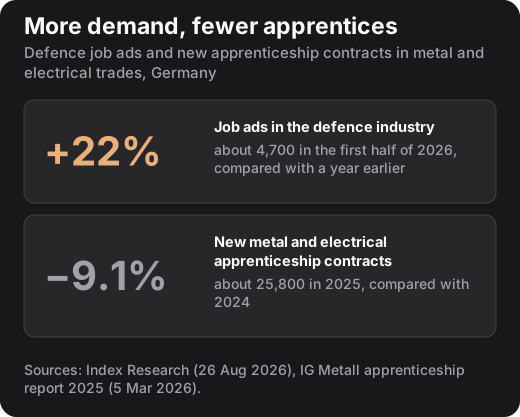
Germany’s defence industry is recruiting. In the first half of 2026 the sector posted about 4,700 job ads, 22% more than a year earlier.
Engineers alone do not build vehicles, radar and munitions. The work needs mechatronics technicians, machinists and electronics technicians, trades that in Germany are learned through the dual apprenticeship system. And it is precisely in these trades that a growing share of apprenticeship contracts ends early, most of them in the first year.
This article sets out the figures trade by trade and shows where employers can make the biggest difference.
Germany’s apprenticeship system in brief
If you work outside Germany, three terms will help you read the figures:
- Ausbildung is the German apprenticeship. In the trades covered here it normally takes three and a half years. Apprentices are employed and paid by a company, trained on site and spend part of their time at a vocational school.
- The chambers of industry and commerce (IHK) organise and grade the final exams. Passing makes the apprentice a qualified skilled worker.
- BIBB, the Federal Institute for Vocational Education and Training, publishes the national statistics used below.
For a defence company with plants in Germany, this system is the main source of skilled production staff. It is also where the pipeline is under pressure.
The 8 key apprenticeship trades in Germany’s defence industry
A note first: there are no statistics for the defence industry alone. The figures below are national and cover all industries. An industrial mechanic at a machine tool builder counts the same as one at a defence supplier.
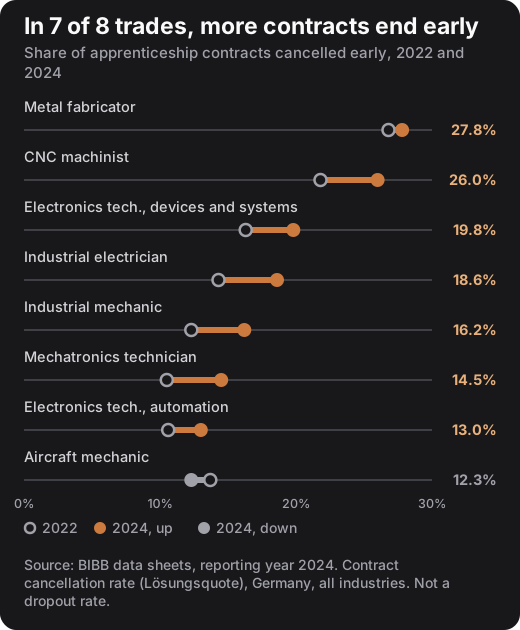
| Trade | New contracts 2025 | Ended early 2022 % | Ended early 2024 % | Pass rate 2024 % |
|---|---|---|---|---|
| Industrial mechanic | 10,383 | 12.3 | 16.2 | 96.4 |
| Mechatronics technician | 8,220 | 10.5 | 14.5 | 96.0 |
| Industrial electrician | 7,371 | 14.3 | 18.6 | 92.2 |
| CNC machinist | 3,717 | 21.8 | 26.0 | 95.7 |
| Electronics technician, automation | 2,211 | 10.6 | 13.0 | 93.6 |
| Metal fabricator | 1,968 | 26.8 | 27.8 | 96.4 |
| Electronics technician, devices and systems | 1,701 | 16.3 | 19.8 | 96.4 |
| Aircraft mechanic | 924 | 13.7 | 12.3 | 94.6 |
Ended early: share of apprenticeship contracts cancelled early (BIBB “Lösungsquote”). Pass rate: share of final exams passed (BIBB “Erfolgsquote I”). Sources: new contracts 2025 from the BIBB survey as of 30 September 2025, all other values from the BIBB data sheets linked at each trade. English trade names are descriptive. The official German titles, in table order: Industriemechaniker, Mechatroniker, Elektroniker für Betriebstechnik, Zerspanungsmechaniker, Elektroniker für Automatisierungstechnik, Konstruktionsmechaniker, Elektroniker für Geräte und Systeme, Fluggerätmechaniker.
How to read the table:
- The talent pool is small. In 2025, about 36,500 new apprenticeship contracts were signed across all eight trades combined. Defence companies, machine builders and automotive suppliers all compete for the same young people.
- More apprentices are lost than before. In seven of the eight trades, the share of contracts cancelled early has risen since 2022. For CNC machinists, more than one contract in four now ends early. The only exception is aircraft mechanics: after 18.4% in 2023, the rate fell to 12.3% in 2024.
- The exam is rarely the obstacle. In all eight trades, more than 92% of final exams are passed. The problem lies at the start of the apprenticeship, not at the end.
More vacancies, fewer apprentices
The demand is clear. According to Index Research, almost 1,600 of the sector’s 4,700 job ads were for technical specialists. The locations with the most ads were Unterlüß, Kassel and Schrobenhausen, home to major Rheinmetall, KNDS and MBDA sites. The German Economic Institute’s skills shortage centre (KOFA) also sees growing shortages in metal and electrical jobs, for example in welding, metalworking and machine building. It links the rising demand partly to Germany’s special funds for defence and infrastructure.
The apprentice intake is moving the other way. According to the IG Metall apprenticeship report, about 25,800 apprenticeship contracts were signed in the classic metal and electrical trades in 2025. That is 9.1% fewer than the year before and almost a fifth fewer than in 2019.
At the same time, many young people are still looking. On 30 September 2025, 39,900 young people were still looking for an apprenticeship, the highest number since records began in 2007. Employers and applicants often fail to find each other. And even when they do, the signed contract is only the start.
Why career changers will not close the gap
Many hope that workers from the car industry, where jobs are being cut, will fill the gap. A study by the Institute for Employment Research (IAB) tempers that hope. Last year, only about 1,100 employees from other industrial sectors moved into the defence industry nationwide. That is three times as many as before 2020. Set against the roughly 15,000 industrial jobs currently lost each month, it is still small.
For most employers, the conclusion is simple: they will have to train tomorrow’s skilled workers themselves. And they will have to keep them.
The exam is not the problem
If you only look at the final exam, apprenticeships look healthy. Between 92% and 96% of exams are passed.
That figure has a blind spot. It only covers exams that are actually taken. An apprentice who leaves in the first year never appears in it.
That group is growing. Across all trades, BIBB reports that 29.7% of apprenticeship contracts were cancelled early in 2024. All eight trades in the table are below that, which is the good news. The bad news is that the trend points upwards. For a company with 20 apprentices per intake, 16% means about three lost contracts, year after year.
Cancelled early does not mean dropped out. BIBB itself stresses that its cancellation rate “is not a dropout rate”. Many apprentices simply change employer or trade and qualify elsewhere. For the company that hired, onboarded and paid them, the investment is gone all the same.
The first year decides
When do contracts end? The BIBB Datenreport 2026 gives a clear answer. This is how all contracts cancelled early in 2024 were distributed:

In industry and commerce, which includes the metal and electrical trades, about 70% of all cancelled contracts end within the first twelve months.
Picture a mechatronics apprentice in their third month. A new workshop, new colleagues, vocational school, and electrical engineering for the first time. They can no longer follow Ohm’s law. They have already asked three times and do not dare ask a fourth. Nobody notices from the outside. This is how the path out of a contract can begin. What mechatronics apprentices have to learn in year one, and where AI tutors help, is covered in training mechatronics apprentices.
Of course, not every contract ends because of the subject matter. No learning aid fixes a conflict at work or the wrong choice of career. But much of what an employer can influence happens in this first year.
How to compare your company with the figures
The table becomes useful once you put your own numbers next to it. A simple calculation per trade is enough:
- Choose your intakes. Take all apprentices in one trade who started at least two years ago, for example all mechatronics apprentices from the 2021 to 2023 intakes. About 90% of all cancellations happen in the first two years, so these intakes are almost complete.
- Count the cancelled contracts. Include every case, whether the apprentice resigned, you terminated the contract or both sides agreed to end it.
- Divide. Cancelled contracts divided by contracts started gives your rate.
BIBB uses a different method, so your result is an approximation. It is good enough for an honest assessment. If you are well above 16% for industrial mechanics, a closer look is worthwhile. If you are below it, you are evidently doing a lot right. With only a few apprentices a year, the figures fluctuate strongly, so combine several intakes.
Finally, look at when the contracts ended. If most cases fall within the first twelve months, you know where to start. A month-by-month plan with warning signs and conversation questions is in preventing apprenticeship dropout.
What a cancelled contract costs
For the conversation with management or finance, two figures from the BIBB cost-benefit survey for the 2022/23 training year are useful:
- An apprentice costs a German employer about €26,200 a year on average. Apprentices recover about 70% of that through productive work, leaving a net cost of about €8,100.
- Recruiting a skilled worker externally costs about €13,700 on average. Compared with earlier BIBB surveys, these recruiting costs have risen by 65%, the net cost of training by only 28%.

Both are averages across all trades. The direction is still clear: an apprentice who leaves in the first year costs you twice. Once for training that produces no skilled worker, and once for the position you later have to fill from outside, with all the cost and uncertainty of recruiting. Our apprenticeship savings calculator gives a first estimate for your company.
5 things to do differently with your next intake
1. Use the probation period for conversations. Schedule fixed check-ins in weeks 2, 6 and 12. Ask specific questions instead of “Is everything fine?”. Our apprentice onboarding guide has a checklist for the first eight weeks.
2. Do not leave theory to the vocational school alone. In the electrical trades in particular, gaps open early and then widen. Short, regular refreshers at work close them, ideally aligned with what the school is teaching.
3. Watch for early signals. More absences, thinner training logs, an apprentice who suddenly stops asking questions. A digital training logbook shows such patterns earlier than a paper folder that reaches your desk at the end of the month.
4. Support your trainers instead of asking more of them. Trainers who look after growing intakes with the same headcount have less time for individual conversations. We have collected seven approaches in Reduce trainer workload.
5. Involve the works council early. In Germany, data on apprentices’ learning progress is a matter for co-determination with the works council. Set up digital tools as support rather than monitoring from the start, and agree the rules together.
And if IT security says no?
In the defence industry, every digital learning tool faces the same question first: where does our data go?
The answer has to be concrete. An AI tutor for apprentices can be hosted entirely in Germany or run in the company’s own data centre. Then no data leaves the company.
It becomes easier still if you start with non-sensitive content. The official training framework, vocational school material and preparation for the first part of the final exam do not require a single internal drawing. Company documents are added only once IT security and export control have approved them. For more on the requirements, see our article on GDPR-compliant AI tools for trainers.
This is how LearnSlice works. Your apprentices get a tutor that is built on the official training framework and your own documents and cites its source for every answer. Your trainers see early who is falling behind.
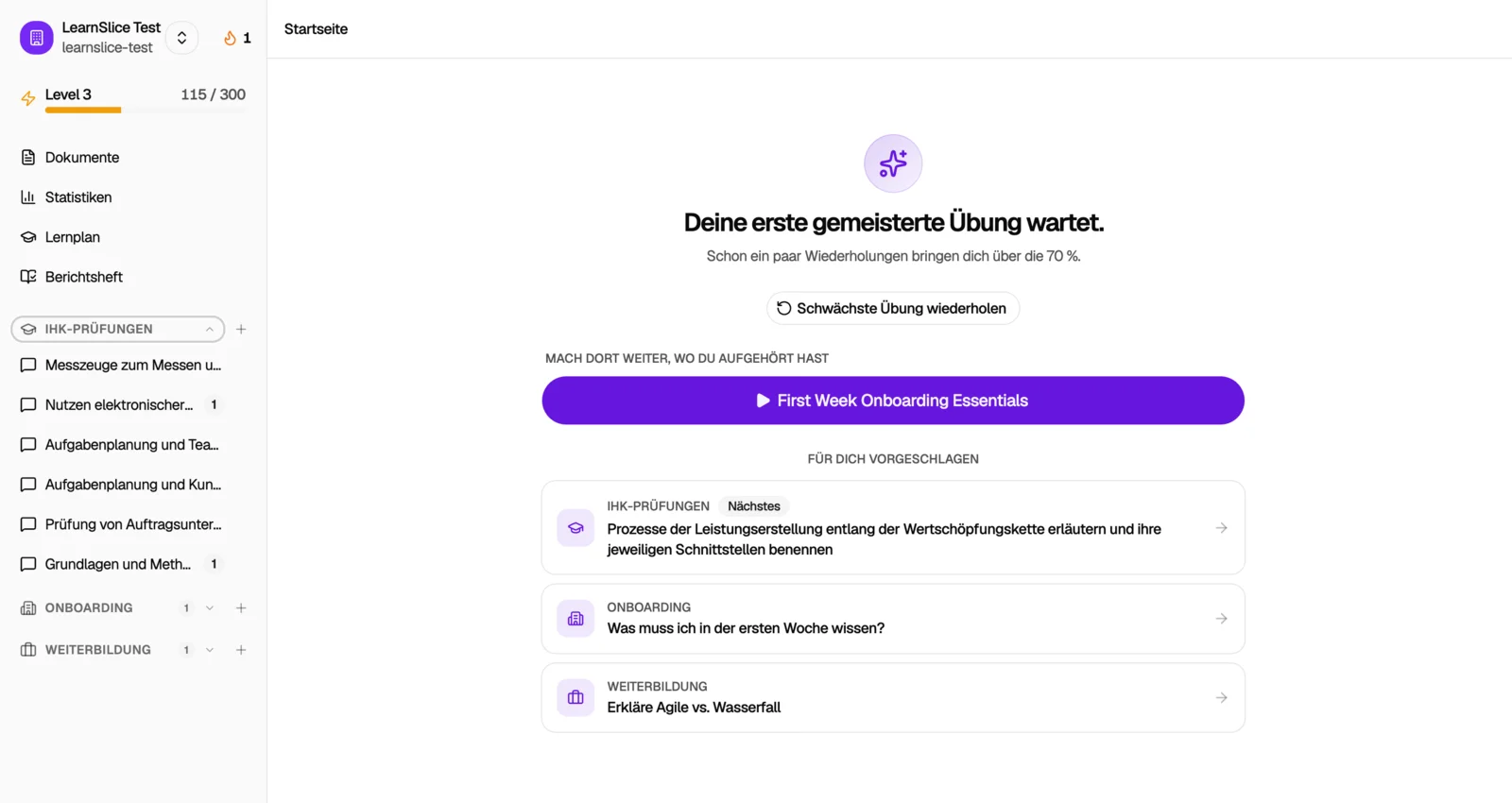
LearnSlice for apprentices (German interface): learning plan, training log and exam topics in one place. The start page suggests what comes next and brings back the weakest exercise.
None of this replaces the conversation in the workshop or a good training culture. But it means the apprentice in month three is no longer alone with their question.
Do you train mechatronics or electronics apprentices? In a short demo we show you how this works with your training plan.
Sources
All figures in this article come from the following sources, checked on 1 October 2026. Most are in German.
- Defence job ads: Index Research, Rüstungsindustrie schreibt 22 % mehr Jobs aus (defence industry posts 22% more jobs), press release, 26 August 2026.
- Apprenticeship contracts in metal and electrical trades: IG Metall, Industrie spart am Nachwuchs: IG Metall fordert Kurswechsel, report on the IG Metall apprenticeship balance 2025, 5 March 2026.
- Moves into the defence industry: Enzo Weber and Yasemin Yilmaz (IAB), Industriebeschäftigung in der Krise: Und sie bewegt sich kaum, Makronom, 21 September 2026 (paywalled). The figures of about 1,100 moves and about 15,000 industrial jobs lost per month appear in a freely available dpa news agency report on the study, here in Handelsblatt, the same day.
- Skills shortages: German Economic Institute (IW), Competence Centre for Securing Skilled Labour, KOFA Kompakt 5/2026: Fachkräftereport März 2026, published 1 July 2026.
- New apprenticeship contracts 2025 by trade: BIBB, survey as of 30 September 2025, table 67.
- Contracts cancelled early and exams passed by trade: BIBB apprentice database (DAZUBI), data sheets for the 2024 reporting year, linked at each trade in the table.
- Timing of cancellations, cancellation rate for all trades, applicants without a place: BIBB, Datenreport zum Berufsbildungsbericht 2026, chapters A1 and A5.6.
- Cost of training and of external recruiting: BIBB press release 23/2025, Duale Berufsausbildung: eine lohnende Investition für Betriebe, 31 July 2025, and the BIBB report by Wenzelmann, Schönfeld, Linckh and Pfeifer (2025), Eigene Ausbildung oder externe Fachkräftegewinnung: mit welchen Kosten müssen Betriebe rechnen?
The BIBB figures are national and cover all industries. There are no statistics for the defence industry alone.
Written by
LearnSlice Team